
Beyond Fun: How Games Shape Skills, Culture, and Community
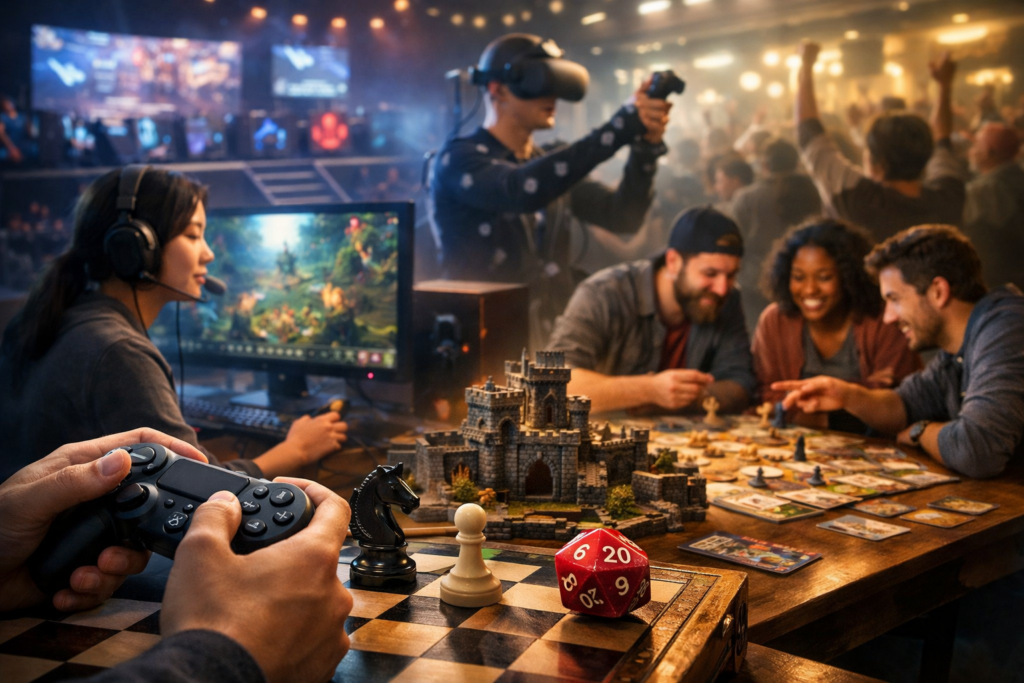
What Counts as a Game?
A game is a structured activity in which players pursue goals under a set of rules, often with uncertainty and feedback. That definition covers everything from chess to mobile puzzle apps, from hide-and-seek to massive online role-playing worlds. Games can be competitive or cooperative, digital or physical, solitary or social. What unites them is a loop of choice → consequence → response: players make decisions, the system reacts, and players adapt.
Unlike many forms of entertainment, games are interactive systems. They invite participation, create measurable outcomes (scores, victory conditions, progression), and encourage repeated attempts. This is why games can feel absorbing: they give you a clear objective, immediate signals about how you’re doing, and a sense that improvement is possible.
Major Types of Games
Games are often grouped by platform, structure, or player experience. These categories overlap, but they help explain why different games appeal to different people.
- Board and card games: Turn-based, social, and often strategy-driven; examples include modern euro-style games, classics like poker, and party games.
- Sports and playground games: Physical skill and teamwork are central; rules may be formal (soccer) or informal (tag variants).
- Video games: Vast range of genres, including action, role-playing, simulation, puzzle, and narrative-driven experiences.
- Tabletop role-playing games (TTRPGs): Collaborative storytelling guided by rules and dice; players co-create worlds and outcomes.
- Puzzles and logic games: Focused on problem-solving and pattern recognition; can be single-player or competitive.
- Esports and competitive ladders: Organized competitive play with rankings, teams, coaching, and spectatorship.
Why Games Feel Engaging
Engagement in games rarely comes from “fun” alone. Great games combine psychological and design elements that keep players invested without relying only on spectacle.
Clear Goals and Meaningful Constraints
Rules limit what you can do, which paradoxically makes choice more interesting. A soccer field has boundaries; a strategy game has limited resources; a puzzle has constraints that define the solution space. Goals provide direction, while constraints create the challenge that makes progress satisfying.
Feedback Loops and Learning
Games teach through feedback. A missed jump in a platformer, a failed negotiation in a TTRPG, or a lost hand in a card game all communicate information. Players iterate, test strategies, and improve—often without noticing they are practicing.
Balanced Challenge
Many games aim for a sweet spot where tasks are neither too easy nor too overwhelming. Difficulty curves, matchmaking systems, and tutorial design all try to keep players in a state of focused effort. When balance is right, players feel capable and curious, not frustrated or bored.
Skills Games Can Develop
Not every game teaches the same things, but games frequently exercise transferable skills. The benefit often comes less from the genre and more from how a player approaches it: reflecting on mistakes, trying new strategies, and collaborating with others.
- Strategic thinking: Planning, risk assessment, and resource management in strategy and management games.
- Spatial reasoning and coordination: Navigation, timing, and dexterity in action and sports games.
- Communication and teamwork: Callouts, roles, and shared decision-making in cooperative games and team-based multiplayer.
- Creativity and narrative skills: World-building and improvisation in sandbox games and TTRPGs.
- Perseverance: Repeated attempts and incremental improvement, especially in challenging “hard” games.
Games as Culture and Art
Games increasingly function as cultural artifacts. They contain visual art, music, writing, performance (voice acting and motion capture), and interactive design. Players don’t just consume a story—they help produce its meaning through choices and play style. A stealth level played patiently tells a different story than the same level rushed aggressively.
Communities also shape what games become. Speedrunners transform games into performance disciplines with their own techniques and ethics. Modders extend a game’s life by building new modes, maps, and narratives. Competitive scenes develop “metas” that evolve like dialects, shaped by shared discovery and experimentation.
The Social Side: From Living Rooms to Global Arenas
Games have long been social anchors: board games at a kitchen table, playground games after school, local tournaments in community centers. Online connectivity expanded that social dimension dramatically. Players can now form teams across continents, join guilds, or attend virtual events that mirror real-world festivals.
At their best, games create belonging. Shared rules make it easier to interact with strangers; a cooperative objective provides a reason to communicate; repeated sessions build familiarity. At the same time, social play can introduce challenges—competition can intensify conflict, and anonymity can enable poor behavior—making community tools and moderation increasingly important.
Healthy Play: Benefits, Risks, and Balance
Like any powerful medium, games can be both beneficial and disruptive depending on context. Thoughtful play can reduce stress, support social connection, and offer a structured way to practice skills. However, excessive play can crowd out sleep, exercise, relationships, and responsibilities.
Practical Ways to Keep Games Positive
- Set clear boundaries: Time windows, stopping points (end of a match or quest), and device-free hours.
- Choose games intentionally: Pick experiences that match your goals—relaxation, social time, challenge, or creativity.
- Watch the monetization: Be mindful of loot boxes, microtransactions, and “fear of missing out” design.
- Protect basics: Sleep, movement, and meals come first; games fit around them, not the other way around.
How to Pick the Right Game for You
With so many options, choosing a game can feel overwhelming. A useful approach is to start with the experience you want.
- For quick relaxation: Short puzzle games, cozy simulations, or casual card games.
- For deep mastery: Strategy titles, fighting games, or skill-based sports and rhythm games.
- For social connection: Party games, co-op adventures, or TTRPG campaigns.
- For storytelling: Narrative-driven games where choices and character relationships matter.
Also consider accessibility: adjustable difficulty, control remapping, subtitles, color-blind modes, and session length can make a game more welcoming and sustainable to play.
The Future of Games
Games continue to evolve alongside technology and society. Cloud gaming and cross-platform play reduce barriers to entry. Virtual and augmented reality experiment with new forms of immersion. Meanwhile, independent developers push artistic boundaries, and educators increasingly adapt game principles for learning. As games grow, the most enduring ones will likely be those that respect players—offering fair systems, inclusive communities, and experiences that feel meaningful long after the final score.
More Articles Like: Beyond Fun: How Games Shape Skills, Culture, and Community

Law in Everyday Life: How Rules Shape Society and Social Change
Law is more than a system of rules enforced by courts; it is a social institution that reflects values, resolves conflicts, and guides collective life. Understanding the relationship between society and law reveals how rights, duties, and justice evolve over time.

Squash: The Fast-Paced Court Sport That Blends Speed, Strategy, and Stamina
Squash is a dynamic indoor racquet sport known for its relentless pace, tactical depth, and full-body demands. From basic rules to key skills and modern global appeal, this guide explains why squash continues to attract players of all levels.

Beyond the Scoreboard: How Sports Shape Bodies, Minds, and Communities
Sports are far more than games played for entertainment. They build physical fitness, mental resilience, teamwork, and social connection while influencing culture, education, and community identity.