
Inside Supercomputing: How the World’s Fastest Computers Solve Impossible Problems
What Is Supercomputing?
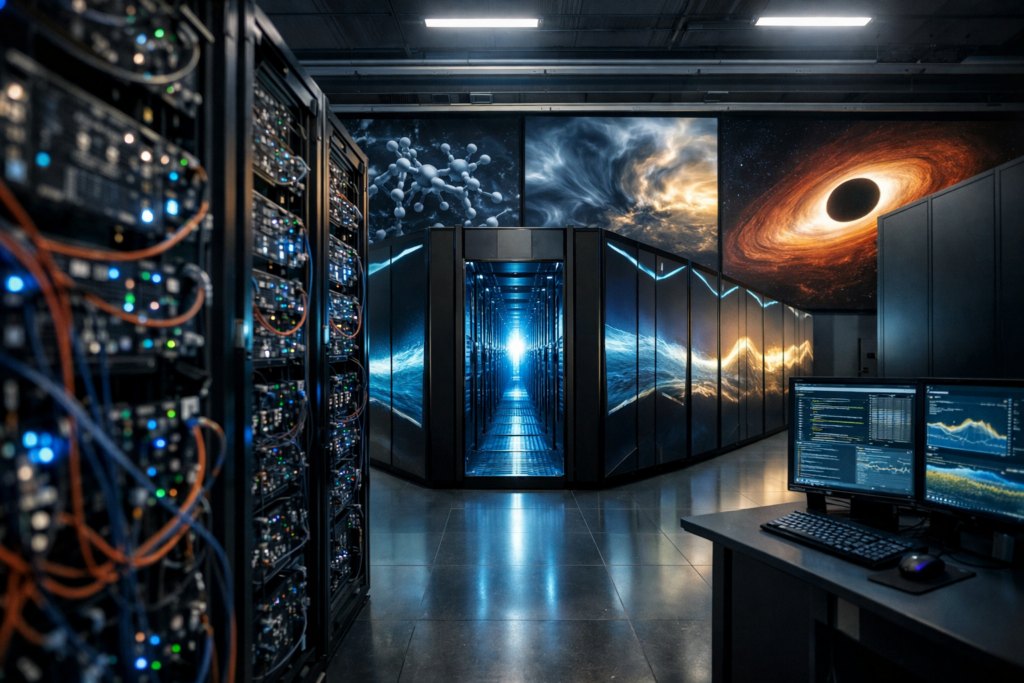
Supercomputing refers to the use of extremely powerful computers designed to perform vast numbers of calculations at extraordinary speed. Unlike personal computers, which are built for general tasks such as browsing, writing, and media consumption, supercomputers are engineered to solve highly complex scientific, engineering, and data-intensive problems. They are measured not just by processor speed, but by their ability to execute massive workloads in parallel across thousands or even millions of computing cores.
At its core, supercomputing is about scale. A desktop machine may run a handful of processes efficiently, while a supercomputer can split a giant problem into many smaller parts and solve them simultaneously. This parallel approach makes it possible to simulate weather systems, model molecular interactions, analyze astronomical data, and train advanced artificial intelligence systems in practical timeframes.
How Supercomputers Are Built
A supercomputer is not simply one oversized machine. It is usually a highly coordinated system made up of many compute nodes connected through ultra-fast networks. Each node contains processors, memory, storage access, and specialized software that allows it to work as part of a larger whole. The true performance of a supercomputer depends on how effectively all these components communicate and cooperate.
Key Components
- Processors: Modern supercomputers use high-performance CPUs, and many also include GPUs or accelerators for tasks that benefit from parallel execution.
- Memory: Large and fast memory systems are essential because scientific calculations often need quick access to enormous datasets.
- Interconnects: Specialized high-speed networking links nodes together, minimizing delays in communication during distributed computation.
- Storage: Supercomputers generate and process huge amounts of data, requiring advanced storage systems with high throughput.
- Cooling and Power: These machines consume significant electricity and produce intense heat, so efficient cooling is critical for stable operation.
Software is equally important. Supercomputers rely on operating systems, job schedulers, optimized compilers, and parallel programming frameworks such as MPI and OpenMP. These tools help researchers divide workloads, assign resources, and extract maximum performance from the hardware.
Performance and the Race for Speed
Supercomputer performance is commonly measured in floating-point operations per second, or FLOPS. Systems once celebrated for gigaflop performance have long been surpassed by machines capable of petaflops and now exaflops, representing quintillions of calculations per second. Reaching these levels requires careful balance among processing, memory bandwidth, network latency, and energy efficiency.
Global rankings such as the TOP500 list have long tracked the fastest supercomputers in the world. These rankings matter because they reflect advances in national research capability, industrial innovation, and technological leadership. However, raw speed alone does not define usefulness. A supercomputer must also run real-world applications efficiently, reliably, and at acceptable energy cost.
Major Applications of Supercomputing
Supercomputers are used where traditional computers would take months, years, or even centuries to produce meaningful results. Their impact spans nearly every advanced field of research and development.
Scientific Research
In physics, supercomputers simulate particle interactions, plasma behavior, and cosmological evolution. In chemistry and biology, they model proteins, molecular bonds, and cellular systems, helping scientists understand disease mechanisms and identify promising drug candidates.
Weather and Climate
Forecasting weather requires analyzing massive streams of atmospheric, oceanic, and land data. Supercomputers process this information to generate more accurate storm predictions, seasonal forecasts, and climate change models. These simulations can improve disaster preparedness and guide environmental policy.
Engineering and Manufacturing
Industries use supercomputing to test designs virtually before building physical prototypes. Aerospace firms model airflow around aircraft, automotive companies study crash dynamics and battery efficiency, and energy companies simulate reservoirs, turbines, and power grids. This reduces cost, saves time, and improves safety.
Artificial Intelligence
Training large AI models demands enormous computational resources. Supercomputers accelerate this process by handling giant datasets and complex neural network operations across many processors at once. They are increasingly central to machine learning research, robotics, and data analytics.
National Security
Governments use supercomputers for cryptography, defense simulations, intelligence analysis, and nuclear stockpile stewardship. In many countries, supercomputing is considered strategic infrastructure because it supports both scientific leadership and security planning.
Challenges in Supercomputing
Despite their power, supercomputers face major challenges. One of the biggest is energy consumption. As systems grow more capable, they can require enormous electrical power, making efficiency a top design priority. Engineers must build architectures that deliver higher performance without unsustainable operating costs.
Another challenge is programming complexity. Writing software that scales across thousands of nodes is far more difficult than creating applications for a personal computer. Developers must account for synchronization, communication overhead, memory bottlenecks, and fault tolerance. Even a small inefficiency can multiply across a massive system.
Data management is another obstacle. Many scientific workflows now involve both simulation and data analysis, creating immense volumes of information that must be stored, moved, and interpreted quickly. This has pushed supercomputing closer to high-performance data science and AI integration.
The Shift Toward Exascale and Beyond
The arrival of exascale computing marks a major milestone in computer science. Exascale systems can perform at least one exaflop, opening the door to simulations and analyses at unprecedented resolution and realism. Researchers can model finer-grained climate patterns, more detailed biological systems, and more complex materials than ever before.
Future supercomputing will likely combine traditional simulation, artificial intelligence, and advanced data processing into unified platforms. Heterogeneous architectures, energy-aware design, quantum research, and new memory technologies are expected to shape the next generation of high-performance computing.
Why Supercomputing Matters
Supercomputing matters because it expands the limits of what humanity can understand and create. It helps scientists test theories that cannot be explored in a laboratory, enables industries to innovate faster, and gives societies better tools for responding to health crises, environmental threats, and technological competition.
Although most people will never use a supercomputer directly, its influence reaches everyday life through improved weather forecasts, safer vehicles, better medicines, smarter AI systems, and more efficient infrastructure. In that sense, supercomputing is not just about the world’s fastest computers. It is about using computational power to solve some of the world’s hardest problems.
Listings Related to the Article: Inside Supercomputing: How the World’s Fastest Computers Solve Impossible Problems

Rhode Island HVAC Services
Rhode Island HVAC Services provides energy-efficient heating, ventilation, and air conditioning solutions tailored to each client’s needs. With dependable service and skilled expertise, they focus on comfort, performance, and customer satisfaction.
Georgia Institute of Technology
The Georgia Institute of Technology (Georgia Tech) is a leading public research university located in Atlanta, Georgia. Known for its innovative programs in engineering, computing, business, and design, Georgia Tech combines cutting-edge research with a commitment to hands-on learning. With a strong emphasis on technology and entrepreneurship, Georgia Tech prepares students to tackle global challenges and drive innovation across industries.
- Category
- Reference » Education » Colleges and Universities

Contabo
Contabo stands out as a premier web hosting and cloud service provider, offering unparalleled computing power at an exceptionally competitive cost. With a commitment to customer satisfaction, Contabo provides award-winning support delivered by real people, not automated bots.
- Category
- Computers » Internet » Web Hosting
More Articles Like: Inside Supercomputing: How the World’s Fastest Computers Solve Impossible Problems

Supercomputing Explained: How Extreme Computing Power Solves the World’s Hardest Problems
Supercomputing combines massive parallel processing, advanced architectures, and high-speed networking to tackle calculations far beyond the reach of ordinary machines. From climate modeling to drug discovery, these systems are essential tools for modern science, industry, and national research.

How Health Organizations Shape Stronger Communities
Health organizations play a central role in protecting public well-being, expanding access to care, and responding to local and global health challenges. From hospitals to nonprofits and international agencies, these institutions help build healthier, more resilient communities.

Beyond the Screen: How Computers Think, Work, and Shape Modern Life
Computers are programmable machines that process data into meaningful results, powering everything from personal productivity to global infrastructure. This article explains how they work, the types you encounter, and the key concepts shaping their future.