
CapacitorJS Compared to React Native and Other JavaScript Frameworks
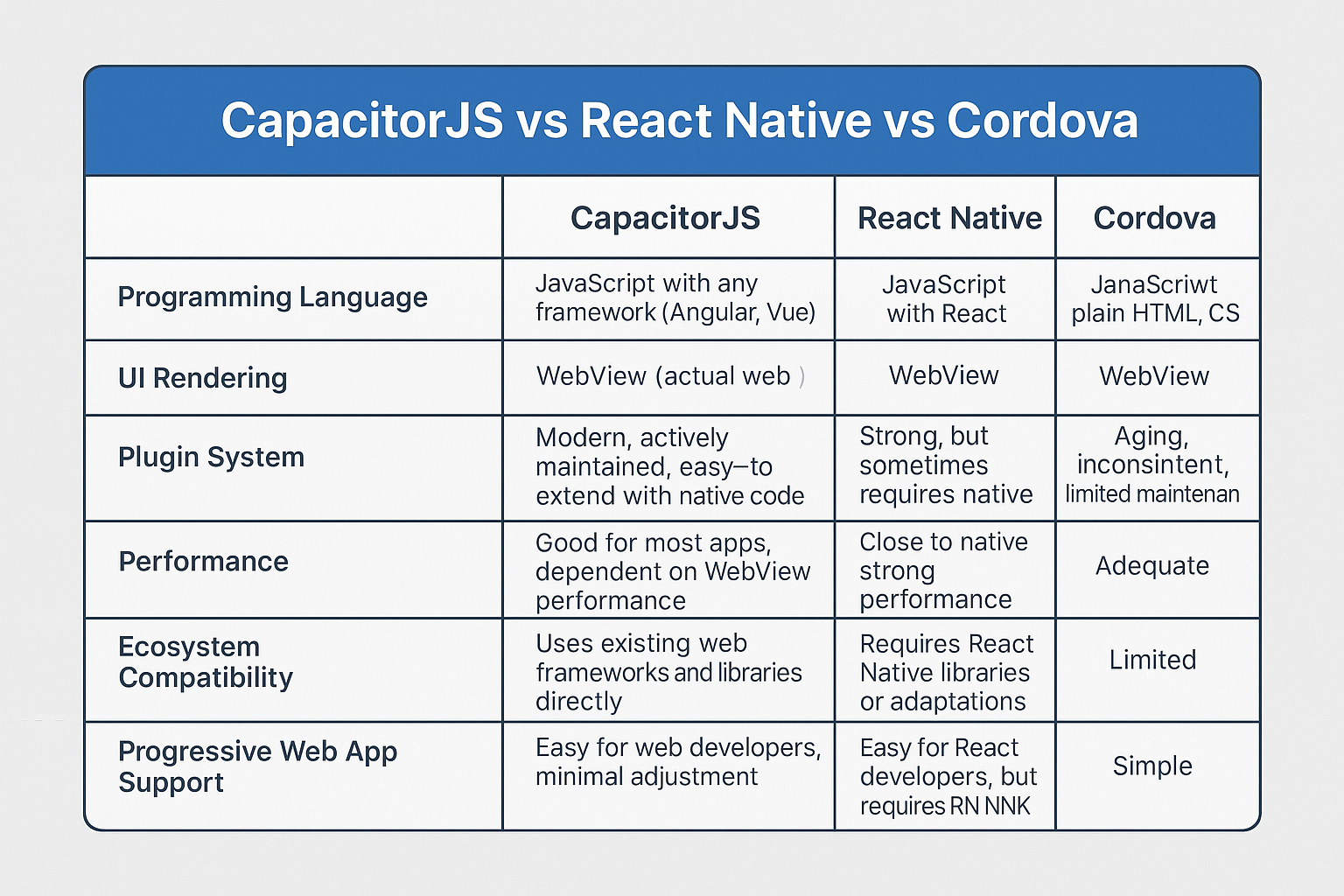
Developers who prefer working in JavaScript have a few main choices when building mobile applications. CapacitorJS and React Native are the two leading options today, while Cordova and older hybrid solutions still exist but are less popular. Understanding the strengths and tradeoffs of these approaches can help teams decide which one best fits their project.
CapacitorJS vs React Native
React Native is one of the most established frameworks for JavaScript-based mobile apps. It enables developers to write apps in React and then bridge to native components for performance and functionality. This makes it possible to achieve an experience very close to native, but it also requires adapting to the React Native ecosystem, which is not always the same as standard web React. Libraries and components sometimes need special adjustments, and extending the app with native modules can involve additional work.
CapacitorJS takes a different route. Instead of creating a special environment, it lets developers use plain web applications and then wrap them for mobile. This means an app written in Angular, Vue, React, or even plain JavaScript can be deployed directly to iOS and Android with Capacitor. Plugins make device features accessible, and if something is missing, developers can add their own native code without abandoning their web codebase. The big advantage here is that developers are not forced into a new React-specific ecosystem — they simply build with the tools they already know and extend only when necessary.
CapacitorJS vs Cordova
Before CapacitorJS, Apache Cordova (and by extension, the original Ionic framework) was the go-to choice for JavaScript developers who wanted to build hybrid apps. Cordova made it possible to package web apps as mobile apps and access device APIs through plugins. However, Cordova’s plugin system has aged, maintenance is inconsistent, and integrating modern frameworks can be frustrating.
CapacitorJS improves upon Cordova by offering a cleaner plugin architecture, better compatibility with modern JavaScript frameworks, and easier integration with native SDKs. It also encourages developers to keep their web apps fully functional, which means the same code can serve as a progressive web app, a desktop app through Electron, or a mobile app.
Quick Comparison
| Feature | CapacitorJS | React Native | Cordova (Legacy) |
|---|---|---|---|
| Programming Language | JavaScript with any framework (Angular, Vue, React, plain JS) | JavaScript with React | JavaScript with plain HTML, CSS, JS |
| UI Rendering | WebView (uses actual web code) | Native components bridged from JavaScript | WebView |
| Plugin System | Modern, actively maintained, easy to extend with native code | Strong, but sometimes requires native work | Aging, inconsistent, limited maintenance |
| Performance | Good for most apps, dependent on WebView performance | Close to native, strong performance | Adequate, but weaker performance compared to newer options |
| Ecosystem Compatibility | Uses existing web frameworks and libraries directly | Requires React Native libraries or adaptations | Works with basic JS, limited ecosystem integration |
| Progressive Web App Support | Yes, same code can run as PWA | No, React Native apps are not web apps | Limited, not designed for modern PWA support |
| Learning Curve | Easy for web developers, minimal adjustment | Easy for React developers, but requires React Native knowledge | Simple, but outdated approach |
| Future Proofing | Strong, built to integrate modern web and native features seamlessly | Solid, but tied heavily to React and Facebook’s ecosystem | Weak, maintenance has slowed and adoption is declining |
When CapacitorJS Makes the Most Sense
For teams that already have strong web development experience, CapacitorJS is usually the smoother option. They can continue using the same frameworks and libraries while extending their apps to mobile. React Native, on the other hand, is better suited for teams that are comfortable with React and want a slightly closer-to-native feel, but are willing to adapt to its ecosystem.
Conclusion
If you want to stay firmly within the web development world while still producing full-featured mobile apps, CapacitorJS provides the most natural path. It avoids the heavy adjustments that come with React Native and improves upon the limitations of Cordova. For JavaScript developers who value flexibility, simplicity, and future-proofing, CapacitorJS is often the smartest choice.
Listings Related to the Article: CapacitorJS Compared to React Native and Other JavaScript Frameworks

Muslim Marriage App India
Nisbat Muslim Marriage App India helps Muslim families and individuals across India find the right partner for marriage. With a focus on cultural values, trust, and long-term commitment, Nisbat provides a respectful way to connect with suitable matches. Whether you are a parent searching for your son or daughter or an individual looking for a life partner, this app makes the process simple and meaningful.

Gretel Labs
Gretel.ai is the go-to synthetic data platform for developers, enabling the creation of artificial datasets with real data characteristics. It’s your key to developing and testing AI models seamlessly while maintaining privacy. With Gretel.ai, innovation meets confidentiality in a streamlined package for the tech-savvy developer.
- Category
- Computers » Companies » Artificial Intelligence

Art Kitchen Direct for Chicago Builders and Developers
Kinzini offers all-encompassing kitchen services to Chicago builders and developers, delivering top-tier contemporary cabinets for kitchens, bathrooms, wardrobes, laundry spaces, and wet bars. Our company was founded to address the demands of developers seeking high-quality, functional solutions at competitive prices.
- Category
- Home » Home Improvement » Kitchens
More Articles Like: CapacitorJS Compared to React Native and Other JavaScript Frameworks

Inside Supercomputing: How the World’s Fastest Computers Solve Impossible Problems
Supercomputing sits at the frontier of modern computing, combining immense processing power with advanced architectures to tackle problems far beyond the reach of ordinary machines. From climate modeling to drug discovery, these systems are reshaping science, industry, and national strategy.

Inside the Thinking Machine: How Computers Turn Ideas into Action
Computers are versatile systems that transform input into meaningful output through coordinated hardware and software. This article explains how they work, the major types, and the key concepts shaping modern computing.

The Intricate World of Computers: Unveiling the Evolution and Impact
Introduction to Computers Computers have become integral to modern life, from personal gadgets to complex systems driving global industries. A computer is a programmable machine capable of executing a series of arithmetic or logical operations automatically to manipulate data. The Evolution of Computers The Early Days The journey of computers began in the early 19th […]