
Supercomputing Explained: How Extreme Computing Power Solves the World’s Hardest Problems
What Is Supercomputing?
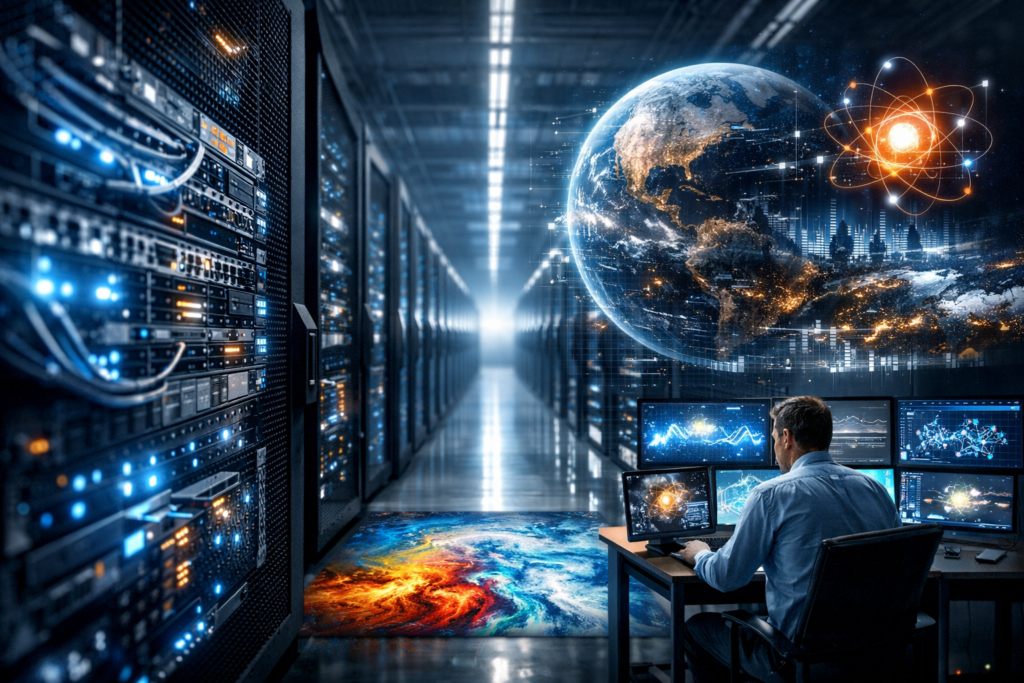
Supercomputing refers to the use of exceptionally powerful computer systems designed to perform enormous numbers of calculations at extraordinary speed. Unlike personal computers or standard business servers, supercomputers are built to handle highly complex workloads that demand intense processing power, vast memory, and extremely fast data movement. Their strength lies not in doing simple tasks one at a time, but in breaking huge problems into smaller pieces and solving many of them simultaneously.
At the heart of supercomputing is parallel processing. Instead of relying on a single processor to complete a job step by step, a supercomputer uses thousands or even millions of processing cores working together. This architecture allows researchers, engineers, and analysts to simulate physical systems, process scientific data, and solve mathematical models that would otherwise take years—or be impossible—to compute.
How Supercomputers Work
A supercomputer is not just one oversized machine. It is typically a carefully engineered collection of compute nodes, storage systems, and networking components working as one coordinated platform. Each node may contain multiple CPUs, GPUs, or both, along with large amounts of RAM. These nodes communicate through ultra-fast interconnects designed to minimize delays when sharing data during calculations.
Performance in supercomputing is often measured in FLOPS, or floating-point operations per second. Modern systems operate at petascale and exascale levels, meaning they can perform quadrillions or even quintillions of calculations every second. Achieving that performance requires optimized software, efficient cooling, specialized file systems, and job scheduling tools that distribute workloads across the machine.
Key Components of a Supercomputer
- Compute Nodes: Individual units that perform calculations using CPUs, GPUs, or accelerators.
- High-Speed Interconnects: Networking technologies that allow nodes to exchange data rapidly.
- Massive Memory and Storage: Essential for loading datasets, running simulations, and storing outputs.
- Parallel File Systems: Designed to read and write enormous amounts of data efficiently.
- Cooling and Power Infrastructure: Critical because supercomputers generate significant heat and consume large amounts of electricity.
Why Supercomputing Matters
Supercomputers are used when the scale, speed, or complexity of a problem exceeds the capabilities of conventional systems. They help scientists model weather patterns, astronomers study the formation of galaxies, and medical researchers analyze molecular interactions for new treatments. In industry, supercomputing supports product design, manufacturing optimization, and financial risk analysis.
One of the most important advantages of supercomputing is the ability to run simulations instead of relying only on physical experiments. Simulations can reduce cost, accelerate discovery, and improve safety. For example, car manufacturers use supercomputers to model crashes and aerodynamics, while energy companies simulate reservoirs and grid behavior before making high-cost decisions.
Major Applications of Supercomputing
- Climate and Weather Forecasting: Modeling atmospheric systems, ocean currents, and long-term climate change.
- Drug Discovery and Genomics: Studying proteins, DNA, and chemical interactions at large scale.
- Physics and Astronomy: Simulating particle collisions, black holes, and cosmic evolution.
- Engineering and Manufacturing: Testing materials, fluid dynamics, and structural performance virtually.
- Artificial Intelligence: Training large machine learning models and analyzing massive datasets.
- National Security: Supporting cryptography, defense modeling, and emergency response planning.
Supercomputing vs. Ordinary Computing
Although both supercomputers and everyday computers process information, their design goals are very different. A desktop or laptop is made for responsiveness, multitasking, and general-purpose use. A supercomputer is built for throughput at extreme scale. It is optimized to run highly parallel applications that require coordinated work across many processors.
Another major difference is software. Supercomputers typically run specialized operating environments and scientific applications written to exploit parallel architectures. Programming tools such as MPI and OpenMP are commonly used to divide work across nodes and cores. Increasingly, software must also be designed to take advantage of GPUs and accelerators, which can dramatically boost performance for certain workloads.
The Rise of Exascale Computing
One of the most significant milestones in the field is the arrival of exascale computing. An exascale system can perform at least one exaflop, or one quintillion floating-point operations per second. Reaching this level has required major advances in processor design, energy efficiency, memory architecture, and software optimization.
Exascale systems open the door to more detailed simulations and faster data analysis than ever before. Researchers can model complex phenomena with higher precision, from fusion energy and earthquake behavior to materials science and pandemic response. However, these gains also bring new challenges, especially in software scalability, system reliability, and power consumption.
Challenges in Supercomputing
Despite its power, supercomputing comes with significant constraints. Energy use is a major concern, as top systems can require enormous electrical capacity and sophisticated cooling solutions. Building and operating these facilities is expensive, and maintaining performance at scale is technically demanding.
Programming for supercomputers is also difficult. Applications must be carefully designed to distribute tasks efficiently, avoid communication bottlenecks, and make effective use of memory. If too much time is spent moving data between nodes, overall performance can suffer. In many cases, the true challenge is not simply having more processors, but ensuring they are all used effectively.
Common Supercomputing Challenges
- Power and Cooling Costs: Extreme performance creates extreme infrastructure demands.
- Software Complexity: Parallel programming requires expert optimization.
- Data Movement: Transferring data can become a major bottleneck.
- System Reliability: With so many components, failures must be anticipated and managed.
- Accessibility: Not every organization can afford dedicated supercomputing resources.
The Future of Supercomputing
The future of supercomputing will likely be shaped by hybrid architectures, AI integration, improved energy efficiency, and closer links with cloud infrastructure. Supercomputers are becoming more versatile, blending simulation, data analytics, and machine learning into unified research environments. This convergence is changing how discoveries are made, allowing scientists to combine traditional numerical models with intelligent pattern recognition.
Quantum computing may also influence the field over time, though it is not a replacement for supercomputing today. Instead, the near future will likely involve complementary systems, where classical supercomputers handle large-scale simulation and data processing while quantum devices address specific types of specialized problems.
As global challenges grow more complex, supercomputing will remain one of humanity’s most valuable technological tools. Whether predicting storms, designing cleaner energy systems, or discovering life-saving medicines, it extends the limits of what computers can achieve and what people can understand.
Listings Related to the Article: Supercomputing Explained: How Extreme Computing Power Solves the World’s Hardest Problems

Rhode Island HVAC Services
Rhode Island HVAC Services provides energy-efficient heating, ventilation, and air conditioning solutions tailored to each client’s needs. With dependable service and skilled expertise, they focus on comfort, performance, and customer satisfaction.

OpenTeQ
OpenTeQ is a proficient software development firm with a worldwide presence and extensive proficiency in providing customized software development services and technology solutions.
- Category
- Computers » Companies » Software Development
More Articles Like: Supercomputing Explained: How Extreme Computing Power Solves the World’s Hardest Problems
Inside Supercomputing: How the World’s Fastest Computers Solve Impossible Problems
Supercomputing sits at the frontier of modern computing, combining immense processing power with advanced architectures to tackle problems far beyond the reach of ordinary machines. From climate modeling to drug discovery, these systems are reshaping science, industry, and national strategy.
Beyond the Screen: How Computers Think, Work, and Shape Modern Life
Computers are programmable machines that process data into meaningful results, powering everything from personal productivity to global infrastructure. This article explains how they work, the types you encounter, and the key concepts shaping their future.

The Power of Reference: How We Point, Prove, and Preserve Meaning
Reference is the act of pointing—linking words, ideas, or claims to something else for meaning, evidence, or context. From language and research to software and everyday conversation, reference systems shape how we understand and trust information.